
The Card Fee a Refund Doesn’t Give Back
Refunds sound like the simplest part of billing. A customer paid too much, so you send some of it back.
Even after a refund, you still lose some money. It just isn’t listed as a cost. It’s hidden in the processing fee, which no longer matches what you actually made.
To find out how much, I did a refund on a test account and wrote down each number as it changed.
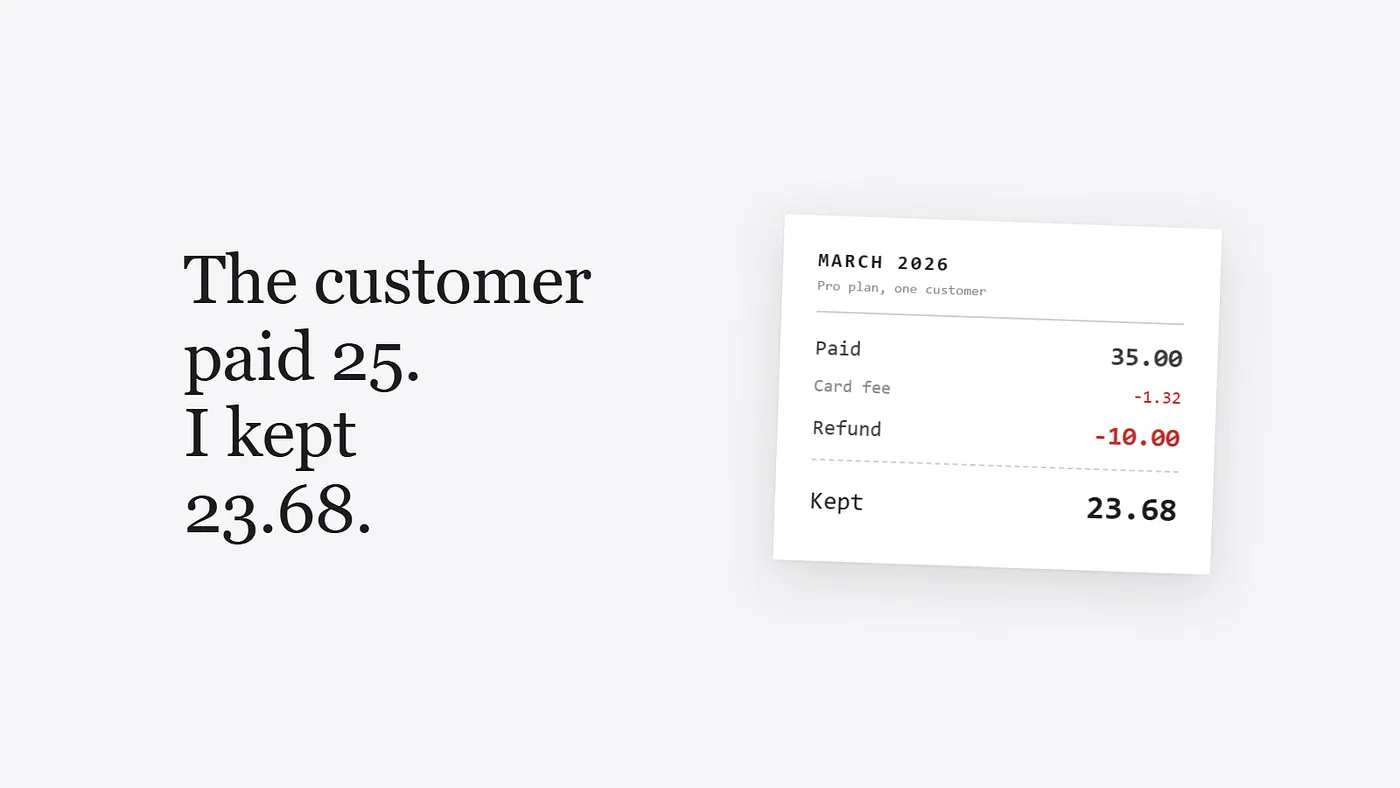
The refund that looked like ten dollars
Alice pays $35 a month for the Pro plan. In March, the service is down for three days, so the business gives her $10 back.
Alice paid $35, got $10 back, so she paid $25 in the end. But the business kept less than that.
Where the money went
When Alice paid $35, the payment company took its fee right away. In my test, that was $1.32.
So at the start of March, the business had:
$35.00 paid by Alice
− $1.32 fee
= $33.68 kept
Then the $10 refund went out. The payment company didn’t charge anything extra, but it didn’t refund the original fee either.
By the end of March, it looked like this:
$33.68 kept
− $10.00 refunded
= $23.68 kept
So Alice paid $25 in total, and the business kept $23.68.
Why the fee stays
The fee pays for moving $35 from Alice’s bank to the business, checking for fraud, and taking on the risk. All of that happened on March 1. Sending $10 back later doesn’t undo any of it.
Now look at it as a percentage. Before the refund, the fee was $1.32 on $35, about 3.8%. After the refund, it’s the same $1.32 on just $25 of real income, about 5.3%.
For one customer, that’s hard to notice. But imagine a bad outage, and 1,000 customers all get the same refund. The business sends back $10,000, and the $1,320 it paid in fees on those payments doesn’t come back. Now that $1,320 is the fee on $25,000 of income instead of $35,000.
Where the refund shows up
After the refund, I checked Alice’s March bill. It still said “Paid, $35”. That’s true, but it can mess up your reports.
When you return a shirt to a store, the cashier doesn’t change your original receipt. They hand you a separate return slip. The receipt still shows $35 because that’s what you paid.
The bill works the same way. It asked for $35 for March, and you paid it. That part doesn’t change. The refund is tied to the payment instead, since the money goes back the same way it came in through the card.
So if your monthly income report only adds up paid bills, it’ll show $35 from Alice for March. But really, $25 came in, and the business kept $23.68.
A better way is to count income from the money that actually moved:
What came in
What went back out
And what the payment company kept
When the refund takes days
The refund doesn’t happen instantly either. On the business side, it shows as “refunded” within seconds. On Alice’s side, the money usually takes 5 to 10 business days to appear on her card statement. That gap can lead to support messages like this one:
“You said you refunded me. I don’t see it.”
That message might arrive on day three, even though nothing has gone wrong. The support person needs a reference number to give her and a simple note saying, “It can take up to 10 business days”
A refund can also go missing. If Alice closed that card last week, the refund can sometimes fail. Someone has to notice and pay her back another way. Otherwise, the business thinks she’s been refunded, but she never gets the money.
What I do instead
If a customer is leaving, or got charged by mistake, I’d refund them, since that money is theirs. For a customer who’s staying, I’d apply a credit to their next bill instead.
Same numbers, but this time the business gives Alice $10 in credit instead of a refund. Her April bill is $35, the credit takes $10 off, and her card is charged $25.
Nothing goes back to her card, so there’s no refund to wait for or to fail. Alice sees the credit on her next bill, clearly labeled. And since the April charge is smaller, the fee on it is smaller too.
In my test account, I also gave a customer $35 of credit before a $35 bill was due. The bill was marked paid, and their card was never charged.
The business still gives up the same $10, but it never pays a card fee on that $10.
What changed for me
What’s different now is how I count it. March income should come from the money that actually moved, because the bill still says $35.
Refunding Alice wasn’t a mistake, and keeping a customer is worth far more than $1.32. But Next time, for a customer like her, I’d try a credit first.
- Payments
- Fintech
- Billing
- Business
- Customer Experience