
The Life of One Subscription
A subscription doesn’t actually take anyone’s money. Most people are surprised by that, including many who build subscription software.
I’ve worked on billing for years, and I keep seeing the same mix-up. People use “the subscription,” “the bill,” and “the payment” interchangeably, as if they mean the same thing. They don’t. Each one is separate and has its own status. When you blur them together, customers either lose access they paid for or keep access they never paid for.
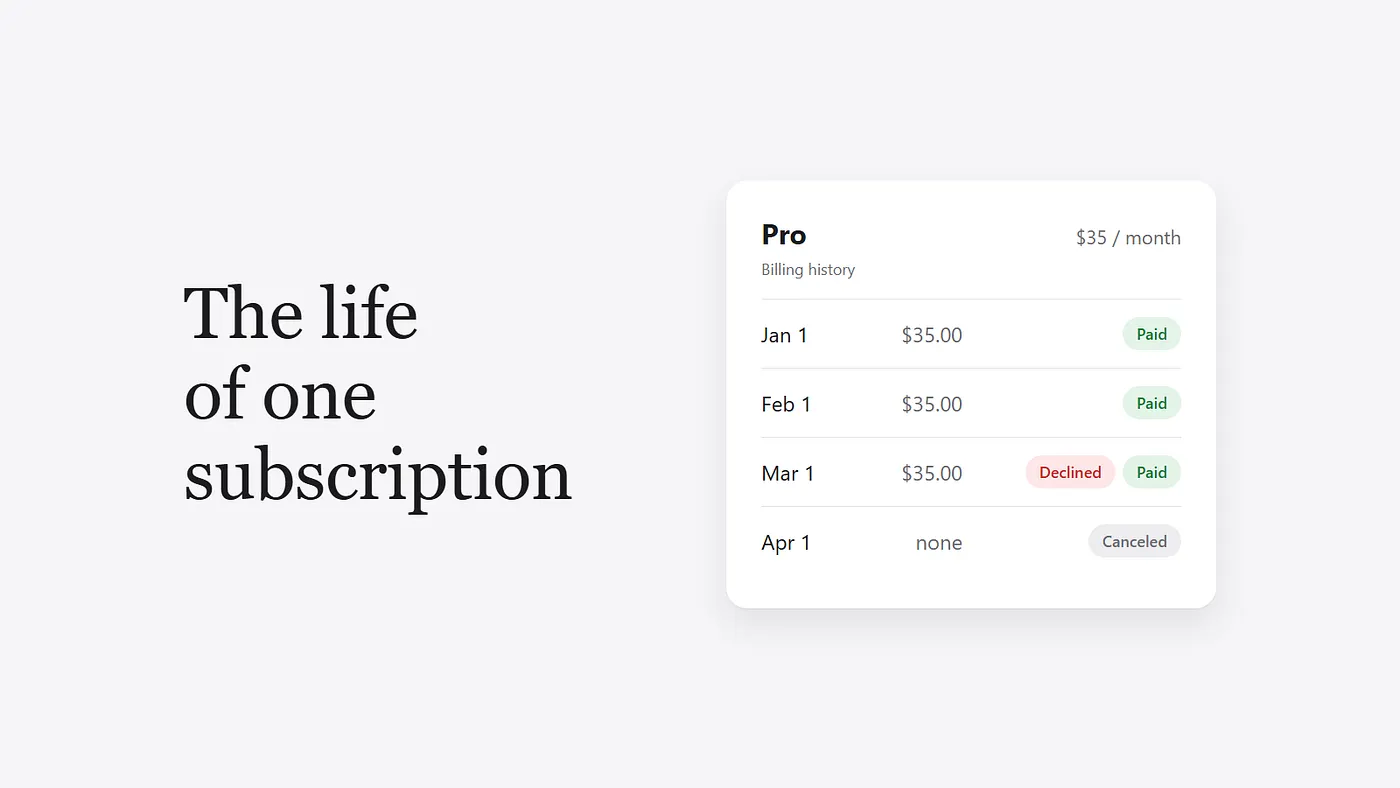
So instead of giving you a list of rules, I’ll follow one subscription from day one to the end. The customer is Alice, and she pays $35 a month for the Pro plan. I’ve worked through this exact case myself, with these same numbers.
January 1: a promise, not a payment
Think of a gym membership. You sign a form that says “$35 on the first of every month until I cancel.” That form isn’t money. It’s a promise of money later.
A subscription is that form. It records three things: who pays, which plan they’re on, and when they pay. That’s all.
A subscription creates a monthly bill. Alice signs up on January 1, and her subscription immediately creates bill #1 for $35.
The bill doesn’t take money either. It requests payment, and only the payment actually charges her card.
So the order is always the same:
- The subscription creates a bill.
- The bill asks for a payment.
- The payment charges the card.
On January 1, the payment goes through. The bill is marked paid, the subscription becomes active, and Alice has access.
One thing about that first day is worth knowing. If her card had been declined, she wouldn’t have been active with a balance due. She’d have been in a waiting state, with 23 hours to fix her card. If she didn’t, the subscription would just expire and never bill her again. When a new customer’s first payment fails, they haven’t really started yet.
February 1: the quiet month
Think of a restaurant bill. The waiter prints it, but before he brings it to your table, you can still say, “Oh, add one more coffee.” Once it’s on the table, the total is set.
On February 1, a month later, the subscription runs. The subscription makes bill number 2, again for $35.
This bill isn’t charged right away. It stays as a draft for about an hour. During that hour, the business can still add things, like extra usage from last month. Then the bill is locked, the card is charged, the payment goes through, and the bill is paid.
Nobody notices any of it. That’s what a normal month looks like, and most months are like this one.
March 1: the card says no
On March 1, bill number 3 is made for $35. The payment runs, and the card is declined.
This is the mistake I see most often: people think a declined card ends the subscription. It doesn’t.
Think about your electricity bill. If one payment bounces, the power company doesn’t cut you off that afternoon. They send a reminder and try again.
The same thing happens here. The bill stays open, still waiting for $35. The subscription switches to “past due,” which just means the last payment failed but the system is still trying. Then it schedules the next attempt. In this exact case, the next try was set for five days later, on March 6.
The payment company I use can be set to try up to 8 times over about two weeks. Only when all those tries fail does the subscription reach its final state. Even then, what happens depends on a setting the business picks: cancel the subscription, mark it unpaid and put it on hold, or leave it past due.
So for those two weeks, the business has a real choice. Should Alice keep using the product while the system keeps trying? Many businesses say yes, at least for a few days. Many declined cards don’t come from bad customers. They come from expired cards or from a bank being cautious. Cutting someone off on day one punishes the wrong people.
March 1, an hour later: one payment, two tries
Alice gets an email, updates her card, and the bill is paid.
Think about a delivery driver who knocks, gets no answer, and comes back an hour later. That’s one delivery with two knocks. It’s not two deliveries, and it’s definitely not a failed one.
This is where reports get confusing. That one bill now has one payment, but two attempts behind it. The first attempt failed, and the second one went through.
If you count attempts, March shows one failure and one success. If you count payments, March is just paid. Count the wrong thing, and your report says Alice didn’t pay in March, even though she paid in full that same day.
The subscription goes back to active. Alice never lost access.
March 3: a little money back
Think about returning one item from a shopping bag. The shop doesn’t tear up your receipt. It gives you a separate return slip, and the original receipt still shows what you paid.
Say the service goes down for three days. To make it right, the business refunds Alice $10.
The refund doesn’t change the bill. Bill number 3 still says paid, $35. The refund is tied to the payment, not the bill, because money goes back the same way it came in: through the card.
There’s also a hidden cost here. The payment company kept its fee on the full $35 and doesn’t refund that fee when you refund part of the payment. That’s a story of its own, so I’ll leave it for now.
March 10: “Stop at the end of the month”
Alice decides she doesn’t need Pro anymore, so she clicks cancel.
Her access doesn’t end that day. She already paid for March, so she keeps the plan until the end of that period, which is April 1. The subscription stays active, with a note that it will end when the current period ends.
That’s how most good cancellations work. Think of a train ticket. If you decide halfway through the ride that you won’t buy another one, nobody throws you off the train. You ride to the stop you paid for.
April 1: the end that was planned
On April 1, the period ends. No new bill is made. The subscription is now canceled, and that’s final. You can’t turn it back on. If Alice returns in June, she’ll start a new subscription.
What the three months teach
- One subscription made three bills.
- One bill had two payment attempts.
- One payment had money sent back.
- One declined card didn’t end anything.
- One cancellation didn’t cut anyone off.
All of this only makes sense if you keep three things separate. The subscription is the promise. The bill is the request for money. The payment is the money actually moving.
So when a customer writes in saying “I was charged, but I can’t get in,” or “I canceled, but I can still log in,” the first question is always the same: which of the three are we talking about? Asking that clears up most billing confusion.
Alice paid $35 three times, got $10 back, had a card declined, and left on the date she picked. A good billing system makes all of that boring. And boring is what you want, because behind every $35 is a person who just wants the thing they paid for to keep working.
- Payments
- Fintech
- Billing
- Business
- Customer Experience